Find out how to check for catch-all email addresses, interpret their verification, recognize important signs and handle unknown addresses to keep your list clean and trustworthy.

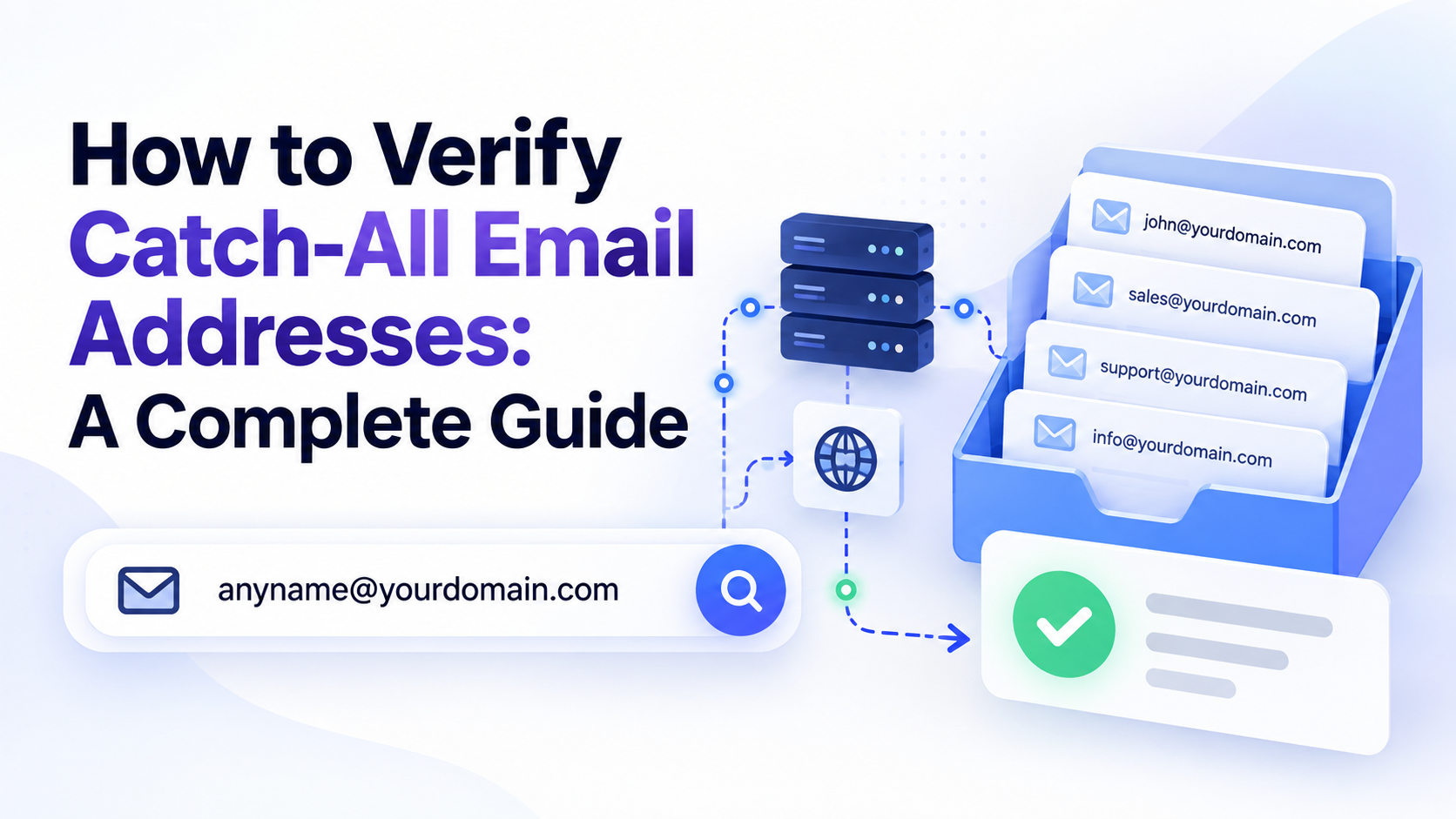
Catch-all email addresses can make verification more complicated because a server may accept messages even when a specific mailbox cannot be confirmed.
This creates uncertainty for businesses managing email lists, outreach campaigns, and customer communications.
Understanding how catch-all domains work, which catch-all email verification signals matter, and how to interpret results can help you handle these addresses more accurately and consistently.
What Is a Catch-All Email Address?

A catch-all email address refers to an email box that is set up to accept emails addressed to various email addresses under one domain despite the absence of such email addresses.
Rather than giving out a bounce-back reply, the domain sends all unmatched emails to a particular email box. Catch-all email verification can be used by companies to ensure that no genuine emails are missed.
Why Are Catch-All Emails Difficult to Verify?

Catch-all configurations create uncertainty because servers accept emails for addresses that may not actually exist. This makes standard verification methods less reliable.
1. They Are Ready to Receive Messages to Unknown Addresses
The catch-all server will deliver all messages regardless of whether there is an actual mailbox to which the message will be delivered. This means that because the server does not reject unknown recipients. The verification software will get a positive answer even when the specific email address cannot be confirmed as belonging to an active user.
2. SMTP Tests May Give False Results
The most popular method to verify catch-all email addresses is by checking their validity with the help of SMTP tests.
However, with catch-all domains, the server will give a positive answer to almost any recipient. This makes it hard for one to tell apart actual mailboxes from those that have been generated by mistake.
3. Domain-Level Validation Is Not Enough
A catch-all configuration would ensure that the domain can accept emails. Although it doesn’t guarantee the existence of the recipient on the said domain.
The validation process could prove the delivery capability at the domain level, although it cannot prove the use of the specific address by the recipient.
4. Uncertainty Regarding the Outcome Is Possible
Since catch-all servers intentionally accept unrecognized recipients, the system could consider it risky, unknown, or even unverifiable instead of clearly valid or invalid.
This uncertainty makes it harder to determine which addresses are genuinely active and suitable for reliable email delivery.
The above limitations make it difficult to verify catch-all addresses. Now lets see how to examine the verification process and the difference between catch-all results and valid, invalid, and suspicious email addresses.
How to Verify Catch-All Email Addresses
Catch-all email verification demands more than just verifying the basic functionality of a mailbox. A mixture of technical indications and verification processes may prove helpful in determining whether an address can be used or not.
1. Test the Domain Configuration
First, you should find out if the domain configuration of the recipient is set to catch-all. This can be done using email verification systems, which determine the reaction of the mail server towards the recipient emails.
The presence of a positive response from unknown addresses indicates that the domain configuration is set to catch-all.
2. Verify the Email Syntax
Next, you should verify if the email syntax is correct. It includes the username, domain name, and other characters.
Syntax verification does not indicate if there is a mailbox; it only filters out improperly formed emails before additional verification methods are applied to the catch-all domain.
3. Evaluate SMTP Responses
SMTP validation can be helpful in terms of understanding how a mail server manages recipient addresses. It is important to note that catch-all servers typically accept unknown recipients.
Therefore, a positive SMTP response is not an assurance that the recipient mailbox is active.
4. Combine Different Validation Indicators
Consider all possible validation signals, such as domain status, SMTP responses, email format, disposable email address recognition, and others, when verifying catch-all addresses.
Since no single check can reliably confirm the mailbox; hence, it is important to consider multiple validation indicators.
It is critical to correctly interpret the results of catch-all email verification since a positive response from a server does not guarantee that the recipient mailbox is active.
It is helpful to understand how catch-all verification results differ from those received during the other types of email verification outcomes. Which provides useful context for evaluating their reliability.
Catch-All vs Valid, Invalid and Risky Email Addresses
Different email verification results suggest various degrees of deliverability and certainty. It is important for you to be aware of this in order to understand what a catch-all result means.
| Email Type | What It Means | Verification Result |
| Valid | The email address appears to belong to an existing, deliverable mailbox. | Strong indication that the address can receive emails. |
| Invalid | The address, domain, or mailbox cannot accept emails. | Strong indication that delivery will fail. |
| Risky | The address may accept emails but has characteristics that create delivery uncertainty. | Requires caution before sending. |
| Catch-All | The domain accepts emails sent to addresses that may not have individual mailboxes. | The specific mailbox cannot be reliably confirmed. |
Knowing the difference helps us to understand the results obtained through email verification. Catch-all emails fall between clear verification outcomes, so their status is different from valid , invalid, or risky.
How EmailAnswers.ai Verifies Catch-All Email Addresses
EmailAnswers.ai makes use of several verification signals that analyze collectively to determine whether a catch-all email address is genuine rather than solely trusting the reply from a server.
The method may review mailbox settings, domain setup, mailbox action, SMTP replies, and other elements that indicate whether an email can be sent or not.
This method helps to identify emails that are really deliverable from those where one cannot be certain that there is a mailbox. By evaluating several signals together, EmailAnswers.ai can provide a more informed verification result for catch-all addresses.
Best Practices for Handling Catch-All Emails in Your Email List
Careful management is necessary for catch-all addresses since server replies will not always indicate the presence of an active mailbox. By using a consistent verification process for such addresses, you could make better decisions.
1. Verify Before Delivery
Emails should be verified before placing them in active email campaigns. Verification will help to determine the type of domain and also give more clues about the address.
Not all catch-all addresses should be assumed valid since the server response will not necessarily indicate whether the mailbox is there.
2. Separate Catch-All Emails
You should put your catch-all addresses in a separate segment from your clearly valid, invalid, and other verified results. It will make their management easy and avoid considering undetermined emails and verified emails in the same category.
Also, segmentation allows you to have specific sending rules that match the verification status of each segment.
3. Monitor Delivery Performance
Monitor bounce rates, failed deliveries, and other performance data after sending to addresses under catch-all categories. Monitoring delivery performance can give more insight into the quality of the addresses.
In cases where delivery issues continue to arise for certain addresses, assess the situation and eliminate such addresses from your mailing list.
4. Refrain from Continued Deliveries to Uncertain Addresses
Sending to addresses that have been found to be uncertain during verification is unnecessary and increases the number of deliveries made.
Catch-all addresses should be reviewed regularly, and uncertain addresses reassessed. Where an address is found to deliver poorly or fail regularly, delete the address altogether.
5. Keep Your List Up to Date
Check your email list on a regular basis to make sure that your list is not composed of any outdated email addresses, inactive emails, and questionable catch-all emails.
Emails and domains may have changed over time, so an address that previously appeared usable may later become unreliable. Routine list maintenance helps prevent old verification results from being treated as permanently accurate.
Managing catch-all addresses carefully helps to maintain clearer verification records and more controlled email list decisions.
Catch-all email addresses may prove difficult to validate since a positive server response is not necessarily an indication that the mailbox exists.
With knowledge about the workings of catch-all email addresses, and the analysis of several verification factors, businesses can be better placed to make decisions regarding their email databases.
Consistent email validation efforts will go a long way towards ensuring the reliability of the email data.
FAQs
What is a catch-all email address?
A catch-all email address belongs to a domain configured to accept messages sent to multiple addresses, including recipients that may not have individual mailboxes
Why is it difficult to verify catch-all email addresses?
Catch-all servers accept messages sent to unknown recipients, so SMTP verification may return positive responses without confirming whether the specific email address belongs to an active mailbox.
How can I verify a catch-all email address?
Review the address format, domain configuration, SMTP reply, and other deliverability factors. Using multiple verification methods and email verification tool
gives a better catch-all email detection compared to only just using the server response.
Are catch-all emails safe to send emails to?
Catch-all email addresses may be deliverable, though the mailbox will be questionable. Delivery needs to be cautious since the acceptance of the email by the server does not imply the existence of the recipient.
What is the difference between catch-all and risky emails?
Catch-all refers to a domain arrangement where unknown recipients can be accepted. Risky refers to an email address that has doubtful deliverability or properties that may make its delivery difficult.
Can EmailAnswers.ai verify catch-all email addresses?
Yes, EmailAnswers.ai is capable of performing multiple checks for catch-all domains, which help in determining the legitimacy of a domain and whether it has deliverability issues despite the fact that mailbox status may be unknown.
How accurate is catch-all email verification?
A catch-all email checker does not assure the existence of mailboxes since these systems can receive mail from unknown receivers. The accuracy of results will depend on available factors like SMTP messages, domain setup, syntax, and deliverability indicators.